
Clinton County Release Meanings
A Clinton County release ends one custody episode. It does not always end every form of custody or supervision. The Clinton County Correctional Facility, known as CCCF, holds local defendants and sentenced people, but it also houses prisoners for other counties, Pennsylvania, the U.S. Marshals Service, and Immigration and Customs Enforcement. A person can leave a CCCF bed for the community, another jail, a state prison, federal transport, or immigration custody. The release entry must be read with the sending authority and destination.
Clinton County released inmates usually disappear from the public current-detainee PDF once the snapshot changes. That absence is not proof of a community release. The useful proof has two parts. A jail or corrections record documents the physical movement, while a court or parole record explains its legal basis. Bail, time served, sentence completion, parole, dismissal, and transfer have distinct effects. The booking number ties those records to the same stay and reduces the risk of confusing people who share a name.
Clinton County Release Types
Release language describes what happened at the end of a stay. Bond or recognizance lets a pending case continue outside the jail. A dismissal may remove the legal basis for that case, though another case or detainer may still hold the person. Time served and sentence completion concern a custodial term. Parole is conditional release while a sentence continues. Probation is court-ordered community supervision and may begin with or without a jail stay. A transfer changes the custodian and should not be called freedom from custody.
| Release entry | What it means | Best next record |
|---|---|---|
| Bail or recognizance | The case continues outside CCCF under a court order. | UJS docket and bail order |
| Time served or sentence complete | The listed confinement term reached its recorded end. | Release entry and sentencing order |
| County or state parole | Physical custody ends conditionally while the sentence continues. | Parole order or Board Decision |
| Dismissed or withdrawn | A case charge ended, but other holds still must be checked. | Disposition and all matching dockets |
| Transfer or detainer pickup | Another county, PADOC, USMS, or ICE took control. | Movement log and receiving-agency record |
- Discharge
- The formal end of a sentence or supervision term, not merely departure from a jail.
- Detainer
- A request or authority for another agency to assume or keep custody.
- Time served
- A sentence credit or disposition based on confinement already completed.
- Parole
- Conditional release before the maximum sentence date, with supervision.
Clinton County Release Record Fields
An operational release record concerns one booking or commitment. The public CCCF PDF is not that record. It shows only people currently housed, their names, booking numbers, and the snapshot time. A focused request can seek an existing booking-and-release face sheet or release-log entry. The office may redact protected personal, medical, security, juvenile, sealed, expunged, or investigation-related material. Not every field is guaranteed to be public.
| Requested field | What it can establish |
|---|---|
| Legal name and identifiers | Which person and custody episode the entry concerns |
| Booking or commitment number | The link between the current list, jail file, and request |
| Admission and release date or time | The recorded start and end of the facility movement |
| Release disposition or type | Whether the event was bail, completion, parole, transfer, or another coded outcome |
| Authorizing or receiving agency | Which court or authority approved or assumed control |
| Destination, if public | Whether the move was toward the community or another custodian |
A release date alone does not explain the law behind the movement. Pair it with the court docket, signed order, or parole notice. Conversely, a docket order may predate the time when CCCF finished processing the person out. Together, the two records provide a stronger Clinton County release finding than either source alone.
Request Clinton County Release Records
Start with CCCF and ask for an existing record, not an explanation or a new report. Give the full name, booking number, and an approximate confinement date. Request the booking-and-release face sheet or release-log entry, with admission and release time, release disposition, and the authorizing or receiving authority. Electronic delivery is often the clearest format. State that lawful redactions are acceptable so one protected field does not obscure the rest.
- Save the booking number from the current CCCF PDF and note the snapshot time.
- Call CCCF at 570-769-7680 and ask whether the routine release entry is available informally.
- If needed, use the county Right-to-Know request route and ask for the exact existing record.
- Request a filed bail, sentencing, parole, or disposition order separately from the Clerk of Courts.
- Keep the response, denial, and appeal dates with the record because online status can change.
The Pennsylvania Office of Open Records says an agency generally has five business days to grant access, deny access with legal grounds, or invoke a permitted thirty-calendar-day extension. An Office of Open Records appeal is generally due within fifteen business days of the response mailing date. The current statewide fee schedule permits stated copy charges, while ordinary electronic delivery and redaction carry no added delivery or redaction fee. Check the live fee schedule before submitting a broad paper request.
Public web retention is different from agency retention. The current PDF is replaced, so it provides no release archive. County records may remain under schedules or litigation holds even when a name no longer appears online. Sealing, expungement, juvenile rules, and limited-access orders can restrict what later appears. Expungement means removal of qualifying criminal-history material under a court order; it does not authorize reconstructing a nonpublic case from old copies.
Note: Ask for the booking photograph in a separate request if needed, since the photo and the release entry are distinct records.
Clinton County Release Access Laws
Pennsylvania's Right-to-Know Law, 65 P.S. sections 67.101 through 67.3104, creates access to many existing agency records but also contains exemptions and recognizes other confidentiality laws. Section 901 sets the ordinary response period, Section 902 governs listed extensions, and Section 1307 addresses fees. The law does not require CCCF to answer questions, give legal advice, or build a custom list that it does not already keep.
The Criminal History Record Information Act, 18 Pa.C.S. sections 9101 through 9183, can affect corrections records. Judicial records also follow court access rules that are not identical to executive-agency requests. Under 18 Pa.C.S. section 9122, expungement is available only in specified circumstances. A no-result after a case becomes sealed, expunged, or limited access should be respected rather than treated as evidence that the custody event never occurred.
Historic Jail and Clinton Releases
Clinton County's original jail opened in Lock Haven in 1852 and still stands at 352 East Church Street. It is not the operating correctional facility. The modern CCCF was dedicated in McElhattan in 1990, and a 148-bed addition opened in 2003. That expansion helped the county hold prisoners for other jurisdictions. Current release questions belong with CCCF or the authority that controlled the confinement, not the historic jail building.
The official county pages display inconsistent facility or administrative location details. The commonly stated physical site is 58 Pine Mountain Road, while the contact material also uses a post office box and another administrative address. Call CCCF before an in-person records visit. This local history matters because sending a request or visitor to the old Lock Haven jail would delay a time-sensitive Clinton County release check.
Search Clinton County Released Inmates
The best Clinton County released inmate search begins with the last known custodian. A current CCCF result shows presence only at the PDF timestamp. An absent result requires more work. A PADOC result applies to a state inmate or department-supervised person, not every short county booking. PA SAVIN can report a custody event, while a court docket can explain the order behind it. Federal and immigration cases require separate systems.
- Identify the last facility, booking number, and sending authority.
- Check the CCCF current PDF only to establish whether the name was listed at its generation time.
- Search Pennsylvania's custody notification and state corrections systems if those agencies fit the case.
- Review all matching Clinton County Magisterial District and Common Pleas dockets for bail, sentence, and later orders.
- Use BOP, the federal docket, ICE, or the sending county when CCCF held an outside prisoner.
- Resolve conflicts by requesting the CCCF release or movement entry with the booking number.
A person can have several cases at once. One dismissal or bail order does not resolve a second docket or detainer. Record the time shown by each source and match identifiers rather than relying on a common name. The Clinton County 24-hour release route uses the same-day fallback because no official feed exists.
PADOC Search for Clinton Releases
The Pennsylvania Department of Corrections Inmate/Department Supervised Individual Locator is the correct tool for someone committed to state custody or supervised by PADOC after state parole. It is not an archive of all CCCF bookings. Search a distinctive surname first, then refine with the first name, inmate or parole number, committing county, county of residence, institution, district office, or other displayed identifiers. A parole district assignment can show that a person has left a state prison but remains under department supervision.
| Locator field | How to use it |
|---|---|
| Last and first name | Begin broadly, then match identity details |
| Inmate or parole number | Use the strongest public identifier when known |
| Committing county | Check whether the state case traces to Clinton County |
| Institution or district office | Distinguish prison custody from parole supervision |
| Release Date | Copy the exact public label and value when the released record supplies it |
The live locator uses the label “Release Date.” It does not call that field a projected or tentative date. A minimum sentence date is normally the first state parole eligibility point, not a guaranteed departure date. The maximum is the sentence endpoint, subject to lawful calculation and other custody. A projected release search must keep those labels distinct.
The PADOC locator shows the search and supervision workflow captured below.
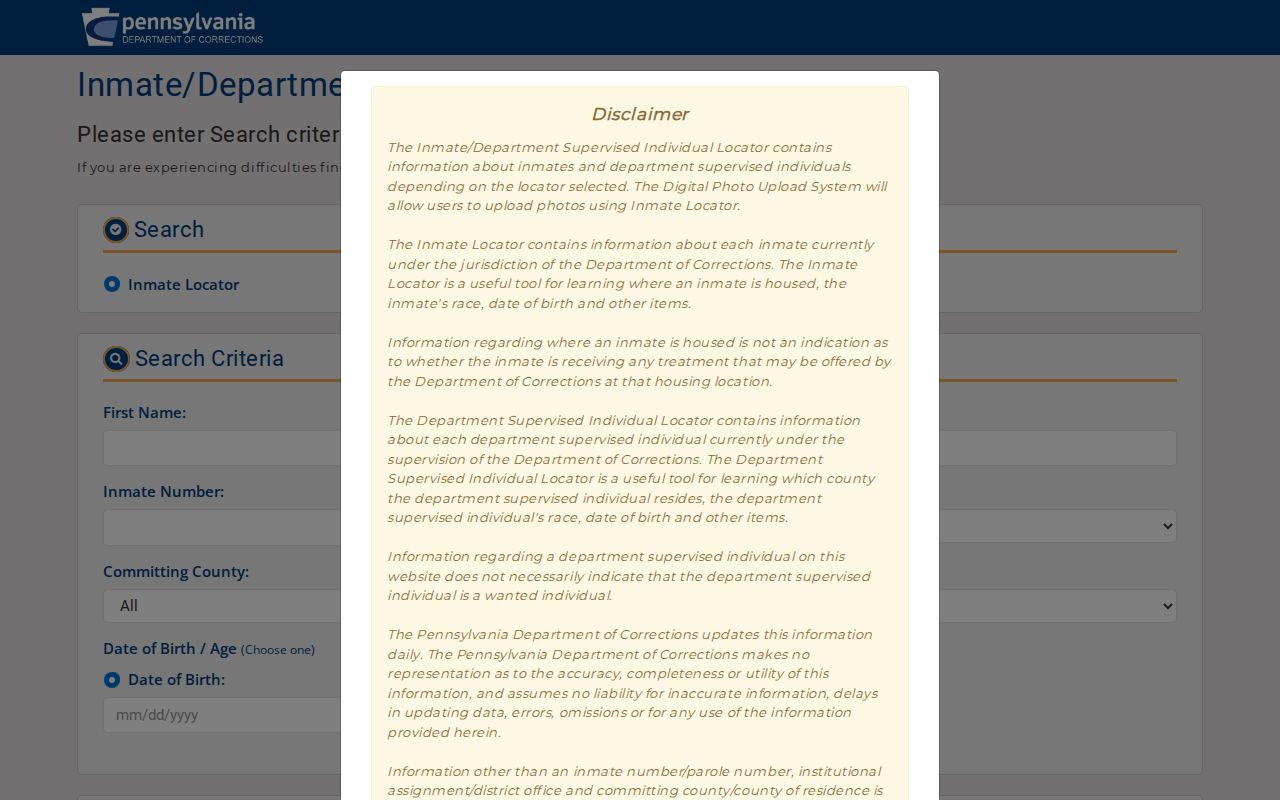
The screen helps distinguish an institution placement from a district-office result, but an official jail or DOC record remains the stronger source for the precise release event.
Clinton County Current List Limits
Clinton County publishes a generated PDF titled “Detainees Currently Housed at Clinton County Correctional Facility.” Its public fields are the detainee name, booking number, and an “as of” timestamp. It has no charge, booking date, release date, release type, photograph, archive, or window selector. No official rolling 24-hour or 72-hour released-person feed was found in the researched county resources.
Do not compare two saved PDFs and label every missing name a release. A difference can reflect transfer, data correction, or movement to another authority. Preserve the booking number, check PA SAVIN, review the court docket, and ask CCCF for the existing release entry. The county gives no public update-cadence or web-retention guarantee, so cite the time printed on the PDF rather than assuming that it refreshes on a fixed schedule.
No. It is a current-custody snapshot. A bounded release-log request or a person-specific PA SAVIN event is the official fallback.
Clinton Release Courts and Dockets
Clinton County's court record is split by court level. Magisterial District dockets cover early and lower-court events. Common Pleas criminal dockets and the Clerk of Courts hold felony and serious-case dispositions, sentences, and filed orders. Search every matching case in the UJS Case Search. Review bail entries, charge outcomes, sentence terms, credit entries, parole orders, and later revocation activity.
A docket status is not a custody status. An active case can continue after bail release, while a closed case can coexist with another detainer. The UJS docket sheet lists filings, but the underlying signed order usually must be obtained from the Clinton County Clerk of Courts. That order explains legal authority; CCCF supplies the physical processing record.
The Pennsylvania court-record page describes the docket access limits shown in this captured screen.
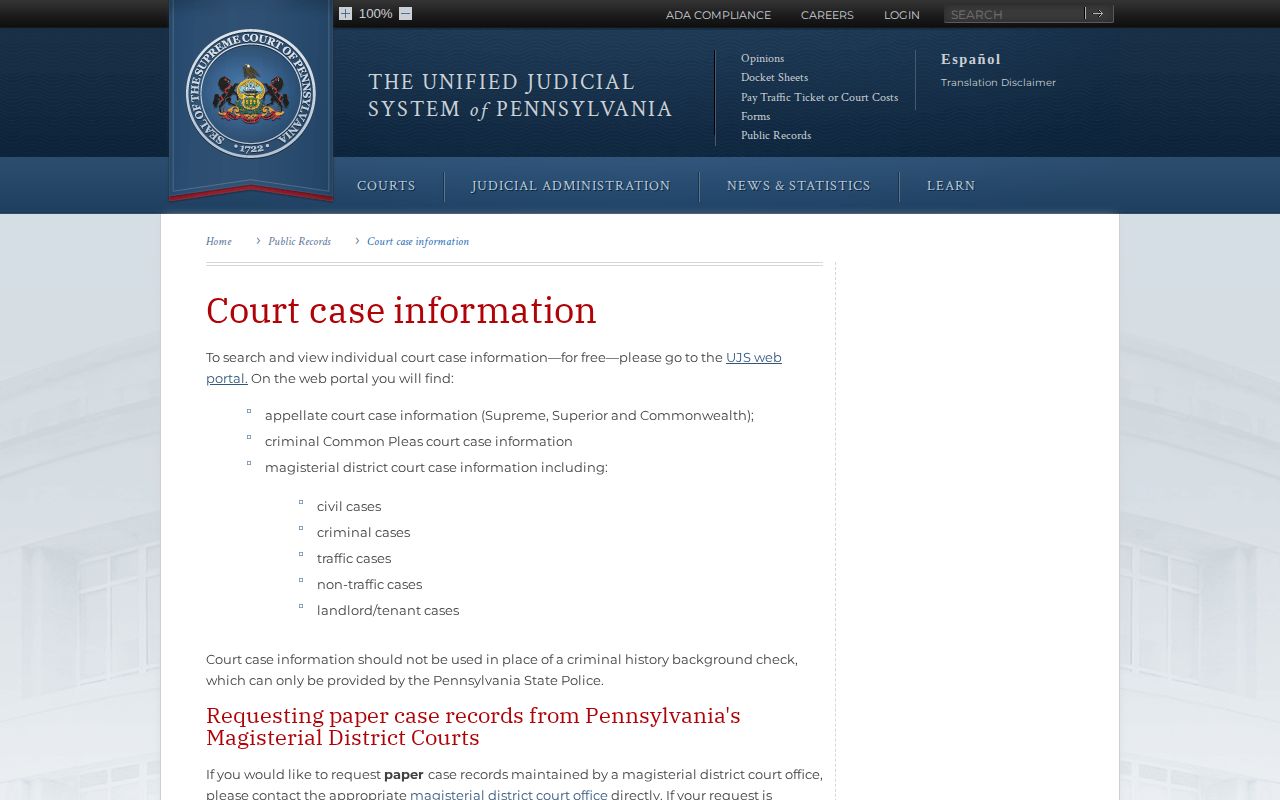
The docket route remains useful after a name falls from the CCCF current list, but it does not prove the exact minute of physical release.
Clinton Release Programs and Courts
CCCF describes Work Release and Community Release options for selected minimum-security participants. It also lists education, counseling, substance-use, mental-health, religious, vocational, and community-service programs. These options can help shape a person's route out of secure custody, but they do not prove final discharge or promise eligibility. “Outside the secure unit” can still be a controlled correctional status.
Clinton County specialty courts coordinate the court, defense and prosecution offices, Adult Probation, CCCF, human-service agencies, and community providers. Their orders can create treatment and supervision paths after custody. Verify the actual order on the docket and contact the administering office for current terms. A program description is not a person-specific release record.
Clinton County Federal Release Transfers
A 2024 ICE inspection reports that CCCF is county-owned, Prison Board-operated, and used for ICE detention through a U.S. Marshals Service intergovernmental agreement. Therefore, “released from CCCF” may mean transfer to ICE, USMS, another federal location, or another jail. A CCCF movement entry should identify the receiving authority, while the federal system explains what happened next.
For a sentenced federal person, the BOP locator can show “Released” or “Not in BOP custody” and a release date. That does not rule out local, state, immigration, or court supervision. A USMS pretrial defendant may have no useful BOP record, so the federal docket and USMS route matter. ICE's current detainee locator is not a release-history archive, and a no-result can mean transfer, release, removal, or a search mismatch. DHS-VINE may supply custody alerts where supported.
The BOP Inmate Locator search and its public released-result fields appear in the captured image.
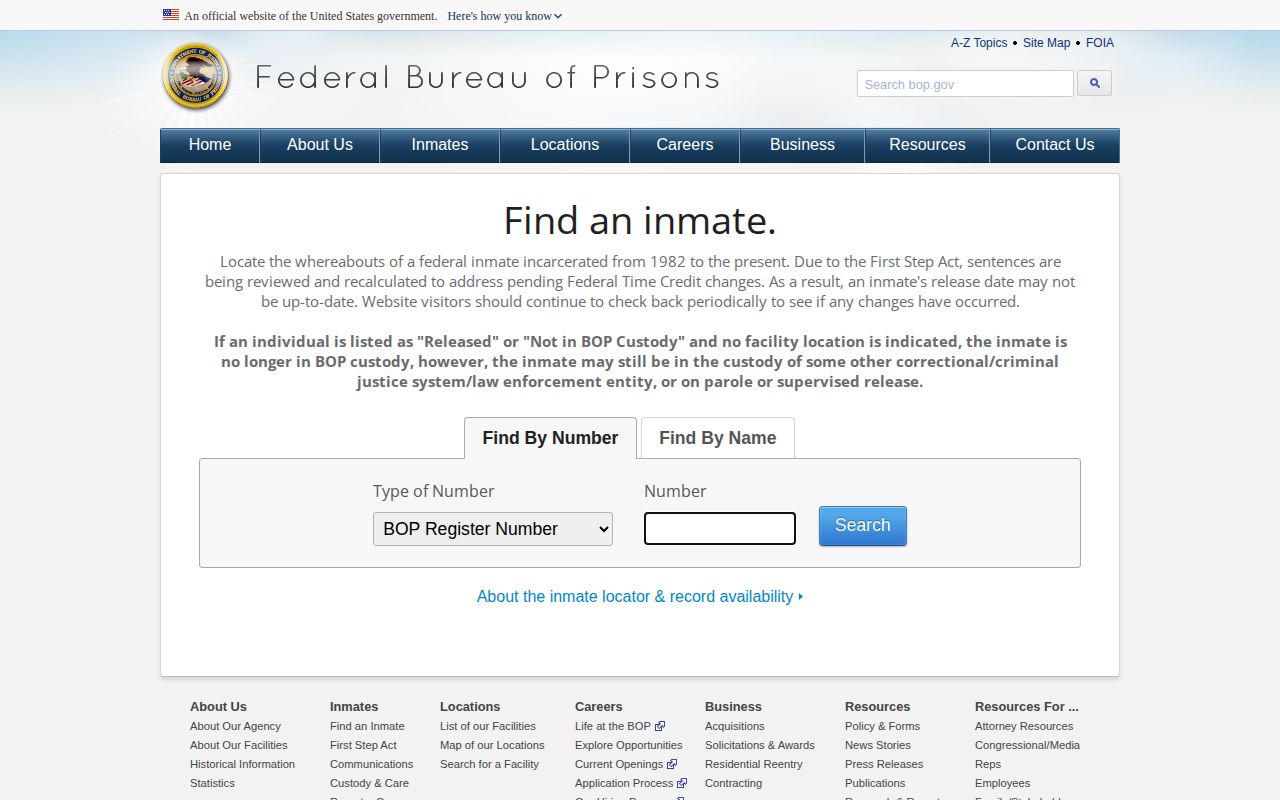
Use the BOP result only for the federal custody episode, then reconcile it with CCCF and the court or agency that controlled the movement.
Who Controls Clinton Release Decisions
The decisive local question is who owned the release decision. Clinton County court and CCCF control ordinary local bail, county sentence, and facility processing. A sending county controls its boarder. PADOC and the Pennsylvania Parole Board control a state sentence and state parole. USMS and the federal court handle a federal defendant, while ICE controls immigration detention. Asking for the booking number and sending authority before choosing a locator prevents a transfer from being mistaken for a community release.
If the sources conflict, write down each timestamp. Call CCCF with the booking number and ask whether the person was released, transferred, or taken by another authority. Then continue with the receiving custodian. This authority-first method fits Clinton County because one current PDF can mix several legal populations that use different release and supervision systems.
Clinton County Release Supervision
The Pennsylvania Parole Board decides state parole, and PADOC supervises a person released to state parole. Clinton County Adult Probation Services handles county probation and local supervision through the Court of Common Pleas. Bail is neither parole nor probation. A probation sentence can follow confinement, run with another term, or begin without jail.
For state supervision, match the PADOC locator result to the inmate or parole number and look for a district-office assignment. For county supervision, start with the signed sentence or parole order, then contact Adult Probation. A parole grant does not equal discharge. The sentence normally continues to its maximum unless another lawful action changes it. Clinton County probation and parole records must preserve that jurisdiction split.
Clinton County Release Notifications
PA SAVIN, delivered through VINELink, covers Pennsylvania county jails, state prisons, and state parole. It can send phone, text, email, or app alerts for reported release, transfer, escape, and custody changes. Search the correct person and agency, compare identifiers, and register before an expected event. A result labeled “Out of Custody” supports exit from the supplying agency but may not state whether the cause was bail, sentence end, parole, or transfer.
Use Pennsylvania VINELink for a specific participating county or state record. It does not replace the BOP or ICE systems. Preserve the alert time and request the underlying CCCF entry when the exact release type matters. The Commonwealth warns users not to depend on one service alone.
Clinton Release Fees After Custody
Clinton County's administrative-orders page lists a 2025 order concerning CCCF collection of fines, costs, fees, and restitution. It also lists a 2024 Adult Probation and Parole Services administrative-fee order. Those obligations can continue after someone leaves physical custody. They are not proof that the person is still jailed, and they do not supply a release date.
Read the individual docket and the applicable Clinton County administrative order before stating an amount or enforcement result. General page copy cannot determine what one person owes. This distinction keeps financial case administration separate from the operational release record.
Compare Clinton County Release Status
Each public system answers a narrow question. Use the source that matches the custody episode, then confirm a release with an operational record and its legal authority.
| Source | What it shows | What it cannot prove alone |
|---|---|---|
| CCCF current PDF | Listed as housed at the printed timestamp | Why an absent person left |
| CCCF release entry | Recorded movement date, type, and authority if public | Every later court or supervision event |
| PADOC locator | State institution or supervision assignment and supplied release data | An ordinary county-only booking |
| UJS docket | Bail, disposition, sentence, and filed-order history | The exact facility processing time |
| PA SAVIN | Participating agency status or custody-change event | The full legal reason for release |
| BOP or ICE locator | The limited federal status each system publishes | Freedom from every other custody or supervision |
Clinton County Release Facilities
Clinton County Correctional Facility is the county's advertised correctional institution. A local detainee may leave on bail, court release, county parole, time served, or sentence completion. An outside boarder may instead return to another county, PADOC, USMS, or ICE. CCCF's release or movement entry is the first local record, and the controlling authority supplies the next one.
Clinton County Courthouse and police temporary holding is short-term judicial or law-enforcement custody, not a public long-term jail with its own roster. A person may move to CCCF, another agency, or the community under a court order. The arresting-agency record and UJS docket are the durable release sources.
Note: No state prison or Bureau of Prisons institution is located in Clinton County, though residents may be confined outside county borders.