
Clinton County Parole and Probation
Parole is conditional release from a jail or prison sentence before the sentence fully ends. Probation is a court-ordered community sentence. It can begin without any jail term, follow confinement, or run at the same time as another part of a sentence. Neither should be inferred from a name disappearing from the Clinton County Correctional Facility list. Bail and pretrial release are different again because they concern a pending case, not post-sentence supervision.
Jurisdiction matters. The Pennsylvania Parole Board makes parole decisions within state jurisdiction, while the Pennsylvania Department of Corrections supervises people released to state parole. Clinton County Adult Probation Services handles county probation and local supervision ordered by the Court of Common Pleas. County parole from a CCCF sentence follows the local sentencing court and county authority, not a public state parole calendar.
| Point | Parole | Probation |
|---|---|---|
| Basic meaning | Conditional release while a custodial sentence continues | A community sentence imposed by a court |
| Clinton County proof | Board or county parole order, custody record, and supervision result | Signed sentencing or probation order and docket entries |
| State authority | Parole Board decides; PADOC supervises | Not the state-parole path for an ordinary county case |
| Local authority | Sentencing court or county authority for a county sentence | Clinton County Adult Probation Services |
| End point | Release does not equal discharge; supervision can continue to the maximum date | Ends under the controlling court order or lawful discharge |
- Discharge
- The lawful end of a sentence or supervision term, not merely release from a secure facility.
- Detainer
- A request or authority that can hold a person for another case or government.
- Absconder
- A supervision label tied to an alleged failure to report or comply, not just an unknown public address.
- Maximum date
- The sentence endpoint calculated under the controlling orders, credits, and later lawful changes.
Verify Clinton County Post-Release Supervision
Use several official records because no one portal covers every Clinton County release. The state locator covers PADOC inmates and department-supervised individuals, but it commonly omits a person whose only confinement was a short CCCF stay. The UJS docket identifies the sentence and later orders. The local office administers county conditions, though staff may withhold confidential case-management details.
- Open the Pennsylvania UJS Case Search, select the proper court level and Clinton County, and match the person by more than a name.
- Read sentencing, probation, county-parole, revocation, and modification entries. Obtain a filed order from the Clerk of Courts when the exact terms matter.
- For a state sentence, search the PADOC Inmate and Supervised Individual Locator. Compare inmate or parole number, committing county, county of residence, and displayed office.
- If the result lists a parole district instead of a state institution, treat that as evidence of department supervision after release, not proof that the sentence has discharged.
- For county probation or county parole, contact Clinton County Court Services and refer to the docket number and signed order.
- Resolve conflicts with the agency that controls the sentence. A current jail list, docket, and supervision portal can update on different schedules.
Clinton County State Parole Results
PADOC integrated state corrections and parole-supervision functions, so one locator can show both a person in an SCI and a department-supervised person in the community. Start with the surname, then narrow the match with a DOC or parole number. Compare the institution or district office and the committing-county fields. A common name alone is weak proof.
The result does not replace the Notice of Board Decision. Questions about an individual decision go through the Pennsylvania Parole Board contact route. Questions about field supervision, home plans, institutions, or reporting an alleged absconder go to PADOC. The Board is also different from the Board of Pardons, whose meeting calendar concerns clemency and is not a schedule of prison parole interviews.
The official parole process screen is useful before interpreting a result. The Pennsylvania Parole Board process page explains that the minimum date creates eligibility, not a promised release.
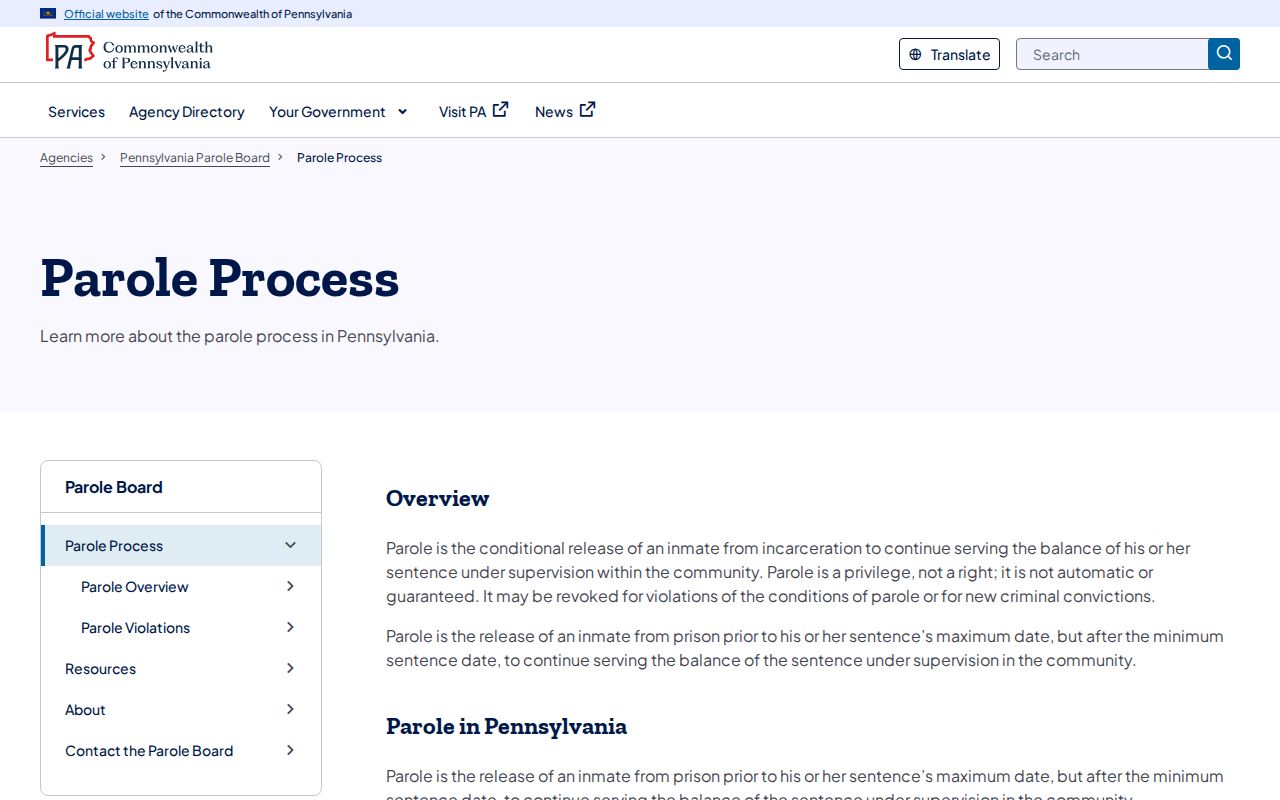
The captured state page supports the jurisdiction and eligibility distinctions used when reviewing a Clinton County state-parole result.
Note: No official public name-searchable calendar of state parole interviews or public database of individual Board Decision notices was found.
Clinton County Supervision Contacts
Route a question by record type. Clinton County Adult Probation Services works through the county court system. The docket and filed order are the public documentary path for county probation or parole. State Board decisions and PADOC field supervision use separate Commonwealth channels.
Clinton County Courts and Adult Probation routeClinton County Courthouse
230 East Water Street
Lock Haven, PA 17745
570-893-4016
Monday, Tuesday, Thursday, Friday: 8:00 a.m. to 5:00 p.m.
Wednesday: 8:00 a.m. to 12:30 p.m.
Judicial records information State parole channels
Board Decision and process questions: RA-PMPBPPWEBCONTACT@pa.gov
PADOC field supervision questions: RA-CONTACTDOC@pa.gov
Parole Board contact page
Ask for the public order or decision by docket number and DOC or parole number when known. Do not ask public staff to disclose a private meeting plan, home plan, or case-management note.
Clinton County Supervision Violations
Conditions come from the controlling order and supervision authority. They can include reporting, approved residence or travel, treatment, payment duties, or other case-specific terms. A violation allegation is not the same as a final finding. Court or Board procedures can include detention, violation, revocation, continuance, recommitment, recalculation, rescission, or later reparole.
No distinct public Clinton County adult-probation absconder list was located. Check the public docket for a warrant, detainer, revocation filing, or hearing entry, then use an official agency channel if reporting information. The Parole Board forms and procedures describe state hearing and administrative processes, but they do not provide a public list of named Clinton County absconders.
PA SAVIN, delivered through VINELink, covers Pennsylvania county jails, state prisons, and state parole. A registered custody or supervision event can be a timely lead, but it is not the full violation record or signed decision. Confirm an alert through PADOC, the Board, CCCF, or the county court that controls the matter. The Megan's Law registry is narrower still. It covers only people with qualifying registration duties and does not function as a parole or probation list.
An absconder label should never be guessed from a stale address or an unanswered call. A detainer may lead to renewed custody, but it can also belong to a different county or government. Read the actual order.
Clinton County Parole Release Timing
A favorable parole action is not the physical release itself. State release can still depend on an approved home plan, program steps, detainers, and institutional processing. The official parole handbook says the institutional parole office handles the release process and that the exact release date is not given to the public. The incarcerated person receives that date and may arrange transportation.
After state-prison release, the handbook directs the person to contact the assigned parole agent within 24 hours unless release occurs on a Friday or holiday. That duty belongs to the person under supervision. It does not make the reporting schedule public. A decision marked parole to detainer can move a person into another authority's custody rather than into the community.
County parole from CCCF requires the local order and release record. The state Board calendar is not the right source. For a clear release trail, pair the Clinton County order with the CCCF movement entry and any later probation or parole record.
Clinton County Reentry Pathways
The Clinton County Correctional Facility describes Work Release and Community Release for selected minimum-security participants. It also lists education, counseling, substance-use, mental-health, religious, vocational, and community-service programs. These are structured routes or services, not proof that a person has been discharged or that any applicant qualifies.
Clinton County specialty courts bring together the court, prosecution, defense, Adult Probation, CCCF, human-service agencies, and community providers. A specialty-court order can shape treatment and supervision after custody. Verify the actual path on the criminal docket and with the responsible program office. Participation should not be inferred from a person having a similar charge or sentence.
The distinction is practical. Someone may spend time outside a secure unit through an approved program yet remain under custody rules. Another person may leave CCCF and begin probation. A third may transfer to state or federal custody. Each path produces different records.
Specialty-court and reentry records also have limits. A public docket may show an order, review date, or program-related filing without disclosing treatment details. CCCF can describe its programs, while Adult Probation can administer the court's terms. Neither source should be used to guess a person's progress. For a current status, identify the exact case and ask only for the public order or agency record that controls it.
Note: Program participation, community release, parole, probation, and full sentence discharge are distinct statuses that require their own official records.
Clinton County Supervision Discharge
Release from confinement does not always end the sentence. A state parolee usually remains supervised to the maximum date unless another lawful action changes the term. County probation ends under the controlling Clinton County order or later discharge. A closed docket alone does not prove the exact end date, and a person can have another active case or detainer.
Confirm the endpoint through the order, docket chronology, and supervising authority. For state records, request the public Board decision or an official PADOC record if the locator is not enough. For county records, obtain the relevant signed order from the Clerk of Courts. The broader Clinton County released inmate search explains how to pair supervision evidence with the jail release record without mistaking one for the other.
A strong finding identifies the person with a docket, booking, inmate, or parole number and names the authority. It also separates release from discharge. That care is especially important in Clinton County because CCCF holds local detainees as well as people for other county, state, and federal authorities.