
Clinton County Projected Release Meaning
“Projected release date” is a useful search phrase, but Pennsylvania records use more exact labels. A court normally imposes a minimum and maximum for an indeterminate sentence. The minimum is usually the first point at which parole may become available. It is not an appointment for release. The maximum is the outer term for that sentence after lawful calculations, though another sentence, detainer, or new custody authority may still prevent community departure.
The PADOC public locator uses the exact label “Release Date” where that field is populated. It does not label the field “Projected Release Date” or “Tentative Release Date.” On a record for someone already released, report that displayed value as the locator's release date. Do not turn it into a promise for someone still confined. The sentencing docket may instead show minimum date, maximum date, custody credit, or parole eligibility, and each label should remain distinct.
| Record label | What it means | What it does not prove |
|---|---|---|
| Minimum date | Ordinary first state-parole eligibility point | A guaranteed release or hearing date |
| Maximum date | Outer term of that sentence after official calculation | Freedom from another case or detainer |
| Release Date | The exact label shown by PADOC where supplied | A public future appointment in every case |
| Board grant | Favorable conditional parole action | Completion of home-plan, detainer, and institutional steps |
| CCCF release entry | Operational end or movement for a county-facility episode | Community release if the person transferred to another custodian |
Find Clinton County Projected Release Dates
Begin with the last known custodian. Clinton County Correctional Facility can hold local pretrial and sentenced people as well as state, other-county, USMS, and ICE boarders. That mixed population makes the sending authority just as important as the jail name. Save the CCCF booking number and match it to the court or agency record before calculating anything.
- Check the current CCCF detainee PDF. Presence shows current listing at its timestamp, but the PDF has no release-date field or future schedule.
- Search the UJS Case Search for all matching Clinton County cases. Read the signed sentence, bail event, custody credit, later modification, and revocation entries.
- For a Pennsylvania state commitment, open the PADOC Inmate and Supervised Individual Locator. Search by surname, then refine by DOC or parole number and committing county.
- Keep the public labels exact. An SCI assignment means state custody; a parole district can show supervision after release; a displayed Release Date is not the same as a minimum.
- For an ordinary CCCF-only sentence, ask the Clerk of Courts for the signed order and CCCF for the sentence-status or release record. PADOC is not the county sentence calculator.
- Check for consecutive sentences, warrants, detainers, or another authority. These can alter physical departure without changing the meaning of one sentence's minimum.
- When dates conflict, use the certified order and official corrections calculation. Note each portal's timestamp.
The Clinton County released inmate search provides the broader custody-system path when it is unclear whether CCCF, PADOC, a federal agency, or another county controls the person.
Clinton County PADOC Release Date
The state locator is appropriate for a person committed to PADOC or supervised by the department after state parole. It is not an archive of every Clinton County booking. Search with a distinctive surname and compare date of birth, inmate or parole number, physical description, committing county, county of residence, institution or district office, and photograph where supplied. The locator warns that some displayed information comes from sources the department has not independently verified.
The official PADOC locator is the source for the public Release Date label and state assignment fields.
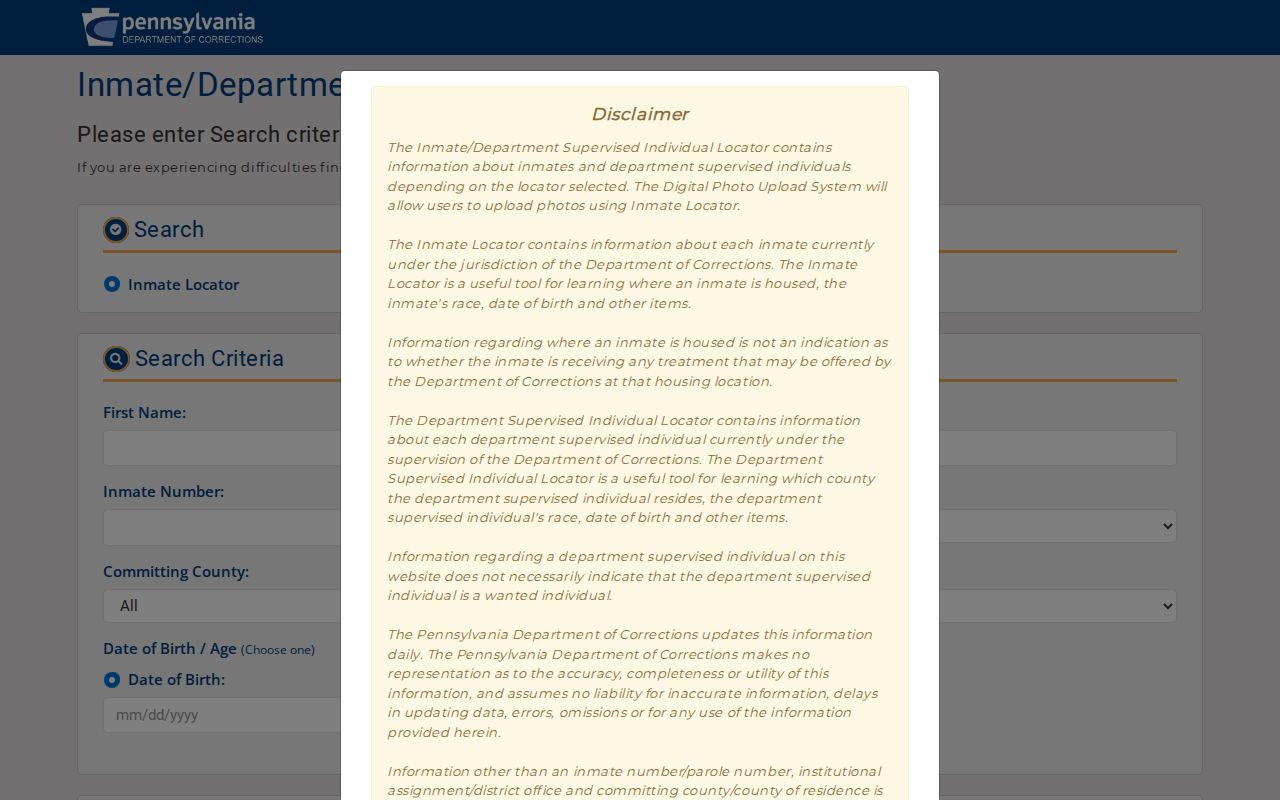
The captured search workflow shows why state records require identity and jurisdiction checks before a date is attached to a Clinton County person.
If the public result is too thin, PADOC Central Records accepts official or certified inmate-record inquiries at RA-centechrecords@pa.gov. Time-calculation questions should identify the inmate number, commitment, sentence order, and claimed credit. A public locator screen is useful evidence, but the certified sentence-status record controls a formal dispute.
Note: A parole-district assignment supports state supervision after prison release; it does not show that the sentence has fully discharged.
Clinton County Jail Release Calculation
A county sentence served at CCCF may be paroled by the sentencing court or county authority instead of the Pennsylvania Parole Board. Under 42 Pa.C.S. § 9756, the court generally states minimum and maximum terms. For qualifying sentences with a maximum below two years and without a conflicting mandatory minimum, the statute can allow the court to identify reentry-plan eligibility through its county process. The signed order is essential.
Credit for time already confined can shift the effective minimum and maximum. Concurrent terms run together to the extent ordered; consecutive terms aggregate. Those words must come from the judgment. Bail release follows a bail or court order and jail processing, not a good-time calculation. A pretrial detainee therefore has no sentence-based projected date.
Weekend or holiday processing may affect administrative timing, but no published Clinton County policy promises an early Friday release for a weekend endpoint. Do not add such a rule to a personal estimate. Ask CCCF records for the existing custody or release entry and the Clerk of Courts for the controlling order.
A simple example shows the limit. If a Clinton County order states six to twelve months and awards thirty days of credit, the minimum may mark the first local parole point after the official calculation. It still does not establish the day CCCF will discharge the person. The court must act where required, staff must process the order, and any consecutive term or detainer must be resolved. Only the official calculation should apply the credit.
- Time credit
- Days officially credited toward the controlling confinement term.
- Concurrent
- Terms that run together as the court directs.
- Consecutive
- Terms that run one after another and may be aggregated.
- Detainer
- Authority or a request that can cause transfer or continued custody for another matter.
Clinton County State Release Rules
Pennsylvania does not use a blanket “serve 85 percent” rule for state parole. The Parole Board's official process page says so directly. Under 61 Pa.C.S. § 6137(a)(3), ordinary Board parole cannot occur before the judicial minimum expires. Eligibility is still not release. The Board can grant, refuse, defer action under the applicable process, or later rescind or revoke.
RRRI, the Recidivism Risk Reduction Incentive, is a separate statutory minimum under 61 Pa.C.S. Chapter 45 for eligible people when the sentencing record supports it. It has offense and history exclusions, and the sentencing court determines eligibility. Short Sentence Parole under 61 Pa.C.S. § 6137.1 applies to a defined class of shorter PADOC commitments. Misconduct, pending charges, warrants, or detainers can disqualify a person under that route.
Neither program is a universal pool of earned days. A sound Clinton County release estimate begins with the signed sentence and official credit calculation, then checks whether RRRI, Short Sentence Parole, or another named authority applies. Private countdown formulas cannot replace those records.
Why Clinton Release Has No Countdown
The most important Pennsylvania quirk is the combination of indeterminate sentencing and confidential release processing. The minimum opens the usual parole window. It does not reveal when the Board will grant release or when institutional requirements will be complete. The official parole handbook says neither DOC nor the Board provides the exact processed release date to the general public, including family and friends, for security reasons.
The incarcerated person receives the date from the institutional parole office and may arrange transportation. A public search can still identify status, assignment, sentence terms, and a populated historical Release Date. It simply cannot create a reliable public countdown. Clinton County county-sentence cases add another layer because the local court and CCCF, not the state Board, may control the calculation.
This is also why the no-85-percent statement matters. Multiplying the maximum by a percentage ignores the judicial minimum, Board discretion, RRRI or SSP eligibility, credit, and other custody. Use official labels and orders instead.
Note: A minimum date is an eligibility marker, while the institutional parole office controls the later physical-release process.
Clinton County Release Date Changes
An expected date can move for legal, disciplinary, or administrative reasons. Some events change the sentence calculation. Others leave one sentence intact but block departure into the community. Treat each factor according to the record that controls it.
| Factor | Possible effect | Best record |
|---|---|---|
| Credit correction | Moves an effective minimum or maximum | Signed order and official sentence-status calculation |
| Concurrent or consecutive ruling | Changes whether terms overlap or aggregate | Judgment and commitment papers |
| Parole action | Grant, refusal, rescission, revocation, or reparole changes the path | Notice of Board Decision or county order |
| Program or home plan | Can delay processing after favorable state action | Institutional parole office record |
| Misconduct or new charges | May affect SSP or RRRI eligibility and create new custody | Official DOC and court records |
| Warrant or detainer | Can cause continued custody or transfer | Agency movement entry and docket |
| Appeal or modified sentence | Can alter the controlling term | Appellate and sentencing-court orders |
Administrative lag can also make two public sources disagree for a short time. Preserve timestamps, then seek the official record. For state issues, the Parole Board's forms and procedures page includes PB-40 for specified time-calculation administrative remedies.
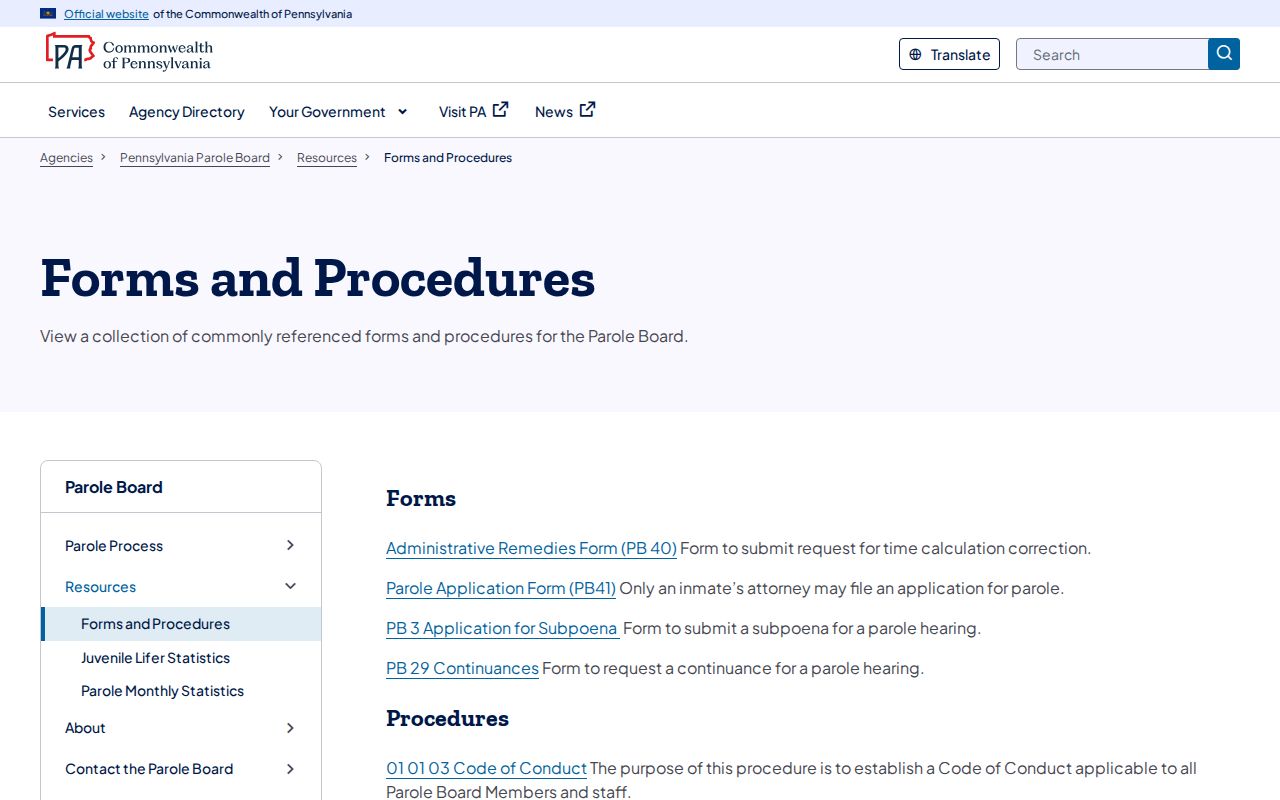
The captured procedures page identifies the formal route for covered calculation claims instead of relying on an unofficial sentence calculator.
Confirm Clinton County Actual Release
For a pending custody change, PA SAVIN and VINELink release alerts can provide a timely event notice for participating county, state-prison, and state-parole records. An alert should be reconciled with the responsible agency because “Out of Custody” may not state whether the event was bail, sentence completion, parole, or movement outside that feed.
For CCCF, ask whether the booking number was released to the community, transferred, or taken by another authority and request the existing release entry. For PADOC, compare the locator with the official sentence record. A USMS, ICE, other-county, or state boarder can leave the Clinton County facility yet remain in custody elsewhere.
The strongest result combines three facts: the calculated sentence or court authority, the operational release event, and the identity number that ties them to the same person. That method avoids both false countdowns and false claims of community release.